DIY Topicals: Safe Combinations, Shelf Stability & What to Watch For

DIY topical treatments (salves, sprays, oils) can be fun, save money, and let you customize exactly what your skin needs. But shelf stability and safety matter—especially when combining ingredients. The wrong mix can lead to spoilage, irritation, or reduced effectiveness. Here’s what to keep in mind whether you’re making your own or buying from someone else. With clean hands, tools, work surfaces, and sterile containers, you can extend usability way beyond basics—check for changes in color, smell, or consistency to know when it’s time to toss.

Key Principles for Safe, Stable DIY Topicals

  • Water-based vs. Oil-based
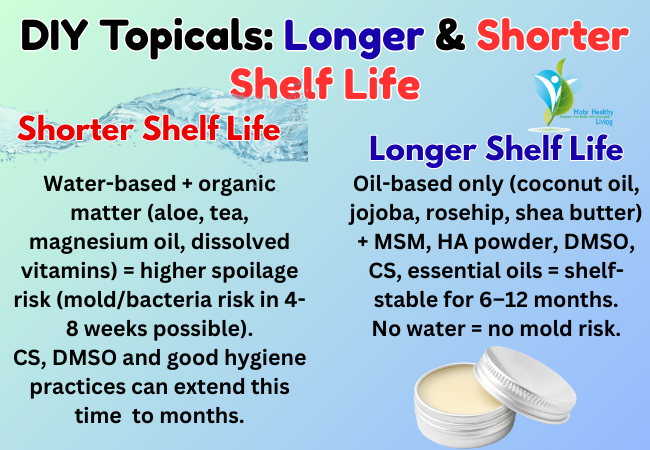
    Water (or anything with water like aloe gel, herbal teas, magnesium oil) + organic matter = potential for bacteria/mold growth if not handled right. These mixes work best refrigerated and used within 4–8 weeks with good hygiene (clean everything first, tight lids, minimal opening), but many folks get months out of them without issues. Always check for spoilage signs.
    Oil-based (coconut oil, jojoba, shea butter) = naturally stable. No water = low spoilage risk. Shelf life: 6–12 months+ in a cool, dark place.
  • Magnesium Oil + HA Example
    Magnesium oil (magnesium chloride dissolved in distilled water) is stable on its own for 6–12 months—it’s a high-concentration brine that naturally inhibits growth.
    Adding HA (hyaluronic acid powder) to magnesium oil adds organics, so aim for 4–8 weeks refrigerated with clean practices, but small batches in sterile containers can go months. Make fresh if in doubt.
  • Colloidal Silver (CS)
    CS is great for antimicrobial support, and it’s water-based. It mixes beautifully with oils (stir in while warm—the water evaporates, leaving silver nanoparticles suspended; no spoilage hit). For water-based mixes (aloe, teas, magnesium oil), CS adds antibacterial boost and can help extend usability (e.g., months with fridge/hygiene), but it’s not foolproof against mold/yeast. Test small batches.
  • DMSO mixed with oil: Stays stable for months (6–12+). Oils are non-polar and low-risk for microbes—no water means minimal growth concerns. Great penetration enhancer without spoilage issues. DMSO mixed with water-based stuff (like CS, aloe, magnesium oil, herbal teas, or dissolved vitamins): Shelf life varies—aim for 4–8 weeks refrigerated with clean handling if adding organics (they can feed microbes if exposed). But simpler combos like DMSO + CS can hold months or more—DMSO and CS both have antimicrobial vibes, so they team up well. Use sterile tools/containers from the start, and check for changes.
  • MSM
    Dissolves easily in warm oil or water. Great for anti-inflammatory sulfur. No major preservation effect, but it plays well with most combos.
  • Aloe Vera Gel, Herbal Teas, or Magnesium Oil
    All water-based → potential for shorter shelf life if not clean, but adding CS/DMSO helps as an antimicrobial boost. Use fresh or in small batches, fridge it or at least a cool, dark place, and check for changes—many hold months with sterile practices like clean hands/tools/surfaces.

Safe DIY Examples (Oil-Based = Long Shelf Life)

  • Hydration Salve (Hands, Feet, Elbows, Knees, Whole Body):
    Carrier oils (jojoba, rosehip, evening primrose) + HA powder + optional MSM/CS. Stable for months—no water.
  • Pain Relief Salve:
    Coconut oil/shea butter + jojoba + MSM + DMSO + optional CS. Stable for months—no water.

Shorter Shelf Life Combinations (Handle Smartly)

  • Anything with water (aloe gel, magnesium oil, herbal tea) + organics (vitamins, MSM, EOs) → Potential for 4–8 weeks or more with fridge, clean tools, and minimal air exposure. CS or DMSO can stretch it to months. Always use common sense: check color/smell/consistency, avoid touching droppers/rollers, and make small batches.

Bottom Line

If you’re making or buying topicals, ask:

  • Is it water-based or oil-based?
  • If water-based, how clean was the process? (4–8 weeks base, months with sterile setup/hygiene)
  • If oil-based and no water added, it’s stable for months—no mold risk.

DIY is empowering when done right. Start simple, keep it water-free for max longevity if you can, and always patch test. Your skin (and wallet) will thank you!

(If you’re buying, ask the maker about stability and storage. Sellers should explain shelf life and storage clearly—your skin deserves that transparency! For water-based, antimicrobials like CS help, but hygiene matters most.)

Why it’s OK to add CS to Oil-Based Salves:

  • When you add CS to warm oil, the water evaporates or gets dispersed as tiny droplets during mixing.
  • The silver nanoparticles (very small, ~10–50 nm) disperse throughout the oil and stay suspended due to Brownian motion and the oil’s viscosity.
  • Result: The silver particles remain active in the oil base, and the mixture stays stable (no separation).

Leave a Reply

Your email address will not be published. Required fields are marked *

This site uses Akismet to reduce spam. Learn how your comment data is processed.